
How to plan,sell, and protect what you’ve built
Selling a business while still running it is no small task. The process can demand so much focus on negotiations and day-to-day operations that little time is left to think about what happens after the deal closes, including how wealth will be invested, how taxes will be managed, and how your values and goals carry forward. With the right preparation, you can protect the value you’ve built and shape the next chapter with intention.
Understanding the journey
We find that there are other challenges inherent in selling a business that can slow the process. Common hurdles include uncertainty as to whether key employees or family members have an interest in running the business, insufficient investment planning to confidently shift away from living off the income from the business, and lack of clarity regarding feasible exit strategies.
Before looking at deal structures or investment models, define what matters to you and your family.
It could be lifestyle flexibility, liquidity for new ventures, or creating a legacy. Once those priorities are clear, the financial strategies can be designed to support them.
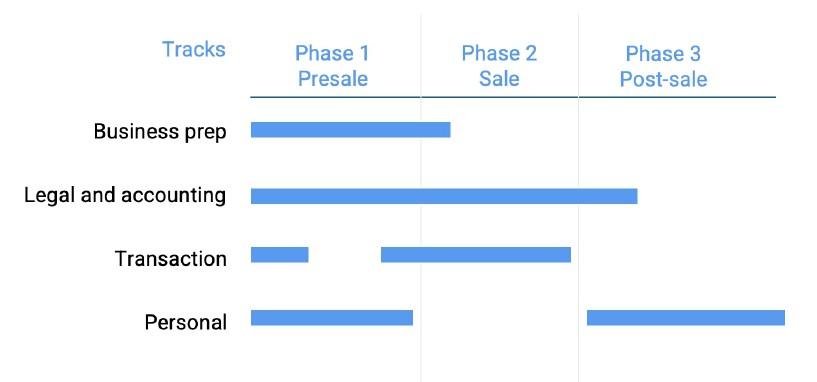
We think of the owner’s journey in three arcs – presale, sale, and post-sale. Each stage involves four ongoing workstreams that move together: preparing the business itself, navigating legal and accounting needs, managing the transaction, and aligning your personal wealth and life planning. The emphasis shifts as the process unfolds, but keeping all four tracks in motion makes sure nothing important is overlooked.
Each track runs through the entire transaction, but the intensity and amount of activity in each track will change depending on the phase. What we have learned:
Presale phase:
the business preparation and personal tracks demand the most attention.
During the sale:
there’s little time for the personal track, and almost all effort is focused on the transaction itself, for example, going to market, soliciting offers, due diligence, and associated accounting and legal components.
Post-sale:
the business prep and legal and accounting tracks have simmered down, and a great deal of focus is typically spent on the personal finance and personal development track. The process is never as neat as it appears on paper.
Presale Phase 3 – Business Track
This phase involves business valuation, identifying the ideal buyer, anticipating buyer questions, preparing answers and tuning up the business. It’s also a time to start developing a vision of life after the sale.
Business preparation
One of the challenging aspects of selling a business is coming to terms with the market’s valuation of the business. Owners frequently believe that their business is more valuable than the market suggests. This belief typically becomes more uncomfortable during the due diligence process, which is designed to drive down the price of the initial offer.
Next, the business owner will need to identify which type of transaction is best; succession to family, management team or financial transaction (strategic buyer, private equity, ESOP, etc) and adjust the business to be more attractive for that kind of transaction.
A serious potential buyer will have a litany of questions that will need to be answered during a due diligence audit: Is the right management team in place? What are the vulnerabilities of the supply chain? Are there soft spots in operations?
Buyers, of all types, will look for points of risk that will allow them to come off their initial offer price, while the owner will try to support the initial valuation by having an answer to every possible question and reducing the risk to the buyer.
This dynamic will continue throughout the transaction and likely during the business’ transition.
All of this leaves many owners asking a familiar question when they first start thinking about an exit:
I’m thinking about selling my company. What steps do I need to take to prepare my business for a transaction?
The prep work begins long before you meet with a buyer. Buyers want to understand how your business really operates.
They look at how decisions get made, how strong the team is, and whether the business can run well without you in the middle of everything.
Take an honest look at the areas a buyer will focus on: your financials, leadership structure, customers, and any parts of the business that rely heavily on you. Tightening things up now helps you stay in control of the narrative when due diligence begins.
A little clarity upfront goes a long way. The more organized and thoughtful the business appears, the smoother the conversations will be once real offers start coming in.
Presale Phase – Personal Track
The personal development track can easily be overlooked. It can be difficult for many business owners to envision a meaningful life after giving up control of their company. The company has typically been a core source of the owner’s identity and has occupied a massive amount of the owner’s available head space.
The sale price: Is it enough?
One of the first considerations business owners should focus on when they consider an exit is whether or not the proceeds will be suitable to fund their future spending goals. A thorough analysis looks at spending goals, investment assumptions, and tax considerations to bring clarity. Sometimes the results show an earlier exit is possible. Other times, they highlight the value of waiting and strengthening the business before going to market.
Give now or later?
In addition to quantifying the current cost of personal spending needs, some families have specific legacy objectives they prioritize. This might include funding trusts, specific philanthropic gifts, or multigenerational bequests.
For those planning to support family or charitable causes, timing matters. Transferring ownership stakes before a sale can shift future growth outside your taxable estate and potentially reduce taxes. These opportunities often disappear if left until the last minute, which is why early planning is so important.
Collaboration
The presale stage often brings surprises, which is why coordination among your legal, tax, financial, and deal advisors is so important. When these professionals work in step with one another, the process runs more smoothly and you’re better positioned to protect both the financial and personal outcomes that matter.
As the technical pieces come together, another question often rises that has less to do with the deal itself, and more to do with the people it affects:
While I’m excited about selling my company, I’m not sure my family is prepared for what lies ahead. What should I be thinking about?
Your family may be trying to understand what this transition means. Before the deal closes, talk openly about expectations and priorities. How will big financial decisions be made? What does life look like without the business in the picture? Are there plans for giving, supporting children, or setting up future generations?
Having these conversations early can make the shift feel more grounded and less stressful. Then the transition that follows the sale tends to feel more stable for everyone.
Sale Phase – Focus on Business
The sale stage is when all the groundwork from the presale phase comes into play. As soon as the business is brought to market, the pace quickens and it can feel like you’re running two jobs –
continuing to lead the business while also managing the transaction.
Offers arrive, due diligence begins, and negotiations move forward, often all at the same time. This surge of activity is exactly why it’s essential to address financial planning, family alignment, and estate considerations early, before the process takes over your full attention. This is also the period where being prepared through the business tune-up will pay big dividends.
There’s nothing pleasant about business owners trying to backfill and scramble to try to retain the highest price they can get for their business. Conversely, a thoroughly prepared owner can confidently oversee the negotiations while holding as many cards as possible.
No matter how well prepared an owner may be, this phase will likely be demanding, and there will be surprises along the way. And even with the best preparation, many owners still have specific questions as the deal moves forward. A common one is:
I know who the buyers are for my company. Why do I need to hire outside experts to help me sell my business?
Even if you already have a good sense of who might buy your company, selling it is rarely as simple as having the right introductions. A sale has a lot of moving parts, from legal details to tax questions, valuation issues, and negotiations that can shift quickly.
Outside experts help you see the full picture. They spot risks you may be too close to notice, keep the process organized, and give perspective at moments when the process can feel fast or overwhelming. This way, you stay focused on the business itself, which is still your biggest asset until the deal is done. When the right team is working together, the process tends to feel more manageable, and you’re better equipped to make decisions for yourself and your family.
Another question that often comes up during this stage is:
How do I maximize the value of my business?
For buyers, value is about what they believe the business can do once you’re no longer in the middle of everything. They want to see stable operations, a strong team, and systems that hold up under pressure. Take a close look at the parts of the business that rely heavily on you and start easing that dependence. Make sure key processes are documented, your leadership roles are clear, and any long-standing risks are addressed before going to market. When a business runs well without the owner, buyers pay attention to that.
Preparing early gives buyers fewer reasons to push back and helps keep the negotiation focused on the real value of the business.
Post-sale phase – back to personal
After the sale of a business, an important transition is shifting from managing an enterprise to
managing personal wealth.
A sound investment strategy not only preserves proceeds from the sale but aligns them with your long-term goals, tax considerations, and tolerance for risk.
Two investment challenges often take center stage:
- Choosing an allocation that supports your family’s long-term goals and risk tolerance
- Deciding how to implement that allocation at a pace that feels sustainable and comfortable
Investors with large amounts of capital to put to work face a tradeoff between the opportunity cost of delayed implementation and the psychological damage that could come from a sharp, immediate decline in their newly-invested portfolio.
Early volatility after a sale can feel especially unnerving. The challenge is more emotional than financial: portfolios built for resilience are meant to weather downturns, but the timing of market moves can test your patience. We focus on the following portfolio management and post-sale strategies to help:
1. Using Direct Indexing for Tax Management and Customization
Direct indexing allows investors to own individual securities that replicate the performance of an index while enabling tax-loss harvesting and customization. For business owners anticipating a liquidity event, direct or leveraged direct indexing can be used strategically to offset realized gains in the year of a sale. This approach helps manage concentrated equity exposure, defer capital gains taxes, and maintain market participation in a tax-efficient manner.
2. Integrating Alternatives for Income and Volatility Management
Alternative investments, such as private credit, real estate, and infrastructure can play a vital role in balancing portfolios post-sale. Unlike traditional equities or fixed income, alternatives often exhibit lower correlation to public markets and can generate consistent income streams.
For example, Perigon’s Enhanced Income Model Portfolio incorporates exposure to private credit and real assets designed to generate enhanced income with downside protection.
Private credit can provide floating-rate income and diversification through senior secured loans to established middle-market businesses.
Real assets, such as real estate and infrastructure, can offer stable cash flow and potential inflation protection through long-term leases or essential service contracts.
3. Building a Durable Income Framework
By combining direct indexing with a diversified mix of alternatives, investors can create a flexible and resilient portfolio, one capable of generating income, managing tax liabilities, and smoothing returns through market cycles.
The objective is not to chase yield or complexity, but to thoughtfully integrate strategies that provide stability and purpose for the next phase of life.
Legacy Planning
Finally, one of the great opportunities that emerges upon coming into wealth is its benefit to the family. While initially exhilarating, this will also come with complexity.
Sudden wealth can be as challenging as it is rewarding for future generations. Preparing heirs through education, structure, and thoughtful family governance ensures the wealth you’ve built supports opportunity without creating unintended burdens. Clarifying the purpose of the family’s wealth can guide decisions for decades to come.
Conclusion
Transitioning out of a business is one of the most significant financial and personal events of an owner’s life. It’s complex, often emotional, and full of choices that carry lasting impact. With the right preparation and the right team, you can approach the process with confidence and turn the value you’ve built into a foundation for the next chapter.
Disclosure
Perigon Wealth Management, LLC is an SEC registered investment advisor. This material is for informational purposes only and is not intended as investment, tax, or legal advice. Investing involves risk. Clients should consult their own legal, tax, and financial professionals before making any investment decisions. Past performance does not guarantee future results. Additional information about Perigon is available at
www.adviserinfo.sec.gov.