
- Global stocks slipped 0.80% in June but still managed to gain 14.93% in Q2, marking their best quarterly return since June 2020, just after the coronavirus pandemic. After creating two new all‑time highs to start the month—bringing the MSCI All Country World Index’s (ACWI) 2026 tally to 30—global stocks were then whipsawed by a sharp selloff in tech shares, coupled with anxiety over rising rates as signaled by the new U.S. Federal Reserve chairman, Kevin Warsh. At one point, the Nasdaq 100 was off over 7% from their June 2nd record close, before finishing the month nearly unchanged at a slight slip of 0.19% MTD following strong earnings from Micron that reiterated the AI growth story. A broadening rally was evident as the small cap Russell 2000 gained 3.60% MTD and 21.15% QTD while closing June at an all-time high. The small cap index has gained 21.86% so far in 2026, posting its best six-month start to a year since 1996.
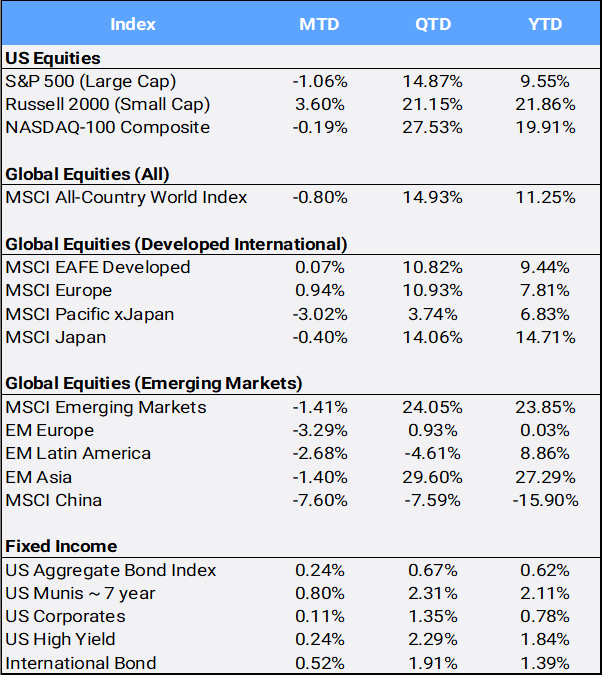
Source: Bloomberg Pricing Data, as of June 30, 2026
Click image to enlarge
- The beginning of the year was characterized by volatility, as the CBOE S&P Volatility Index (VIX), referred to as “the fear index”, traded as high as 35.31 on March 9th, and finished June at 16.45, up 10.03% from where it started the year. While the major averages hit all-time highs, they did so despite wild swings in energy prices due to the Iran war as well as uncertainty around the sustainability of AI spending. However, the second quarter has been especially strong for stocks, as fears around the AI trade eased on blockbuster semiconductor earnings, energy costs retreating towards their pre-war levels, and an interim peace deal reached by the US and Iran earlier this month.
- Sector performance was mixed in June, with four sectors slipping and seven gaining. Communications was the laggard, down 7.78%, while industrials led, rising 7.26% and bringing QTD returns to a second‑best 14.85% and YTD returns to a leading 20.15%. Technology slipped 3.28% in June but still retains the best QTD performance at up 31.79% to bring their YTD returns to 19.76%. Energy slipped 4.87% in June to bring its QTD drop to 12.54% as the worst Q2 sector performance. Yet, on the year, energy stocks are in second place, gaining 20.58% YTD. The effective reopening of the Strait of Hormuz pushed oil prices back to pre-war levels, leading to Q2 weakness in energy stocks which have a correlation with the wild 2026 ride of Crude: -20.44% MTD, -31.45% QTD, yet still up 21.04% YTD. The cost of a barrel stands at $69.50 at the end of June after starting the year at $57.42.
- Declines in energy prices and inflation expectations impacted precious metals, as did strength in the dollar. After gold and silver posted skyrocketing performance in 2025, gaining 64.58% and 147.95% respectively, the precious metals are off 11.72% and 22.18% MTD, down 14.14% and 22.04% QTD, bringing their YTD declines to 7.21% and 18.23%, respectively. The diversified Bloomberg Commodity index fell 8.54% in June, and 8.08% QTD, yet remains up 14.36% YTD. After depreciating 9.37% last year against a diversified basket of currencies, the US dollar index appreciated 2.27% in June to bring YTD returns to 2.91%. The Japanese Yen depreciated 2.02% versus the greenback in June, sinking to 40-year low 162.55 yen per dollar exchange rate – keeping investors alert for possible intervention by the Japan Ministry of Finance. The Bank of Japan recently raised its benchmark interest rate to 1%, its highest level in over thirty years as the country grapples with inflationary pressures, partially fueled by higher energy prices due to the Iran conflict.
- Micron Technology was the largest contributor to global stock returns in both Q2 and the first half of the year, gaining 241.67% and 304.43% over those periods. It delivered another exceptionally strong report that reinforced expectations of ongoing robust demand for memory chips. However, the story, which can be seen as reinforcing the bull case for AI-related capital spending, was undercut by Apple’s subsequent announcement that they would no longer absorb surging chip costs and would therefore be raising prices on their many popular devices for their loyal consumers to bear. This led to a selloff in several of the company’s “Mag Seven” peers, which, as an equal‑weighted group measured by Bloomberg, fell 8.85% in June. A popular internet jest suggests the group may be rebranded as the “Lag Seven,” as Bloomberg’s calculated benchmark (BM7P) is underperforming QTD and YTD, returning 11.62% and ‑1.74%, respectively. By comparison, the average S&P 500 stock, as measured by the SPW equal‑weight index, gained 2.18% in June, bringing its QTD performance to 11.39% and its YTD gain to 12.21%.
- Some speculated that investors trimmed exposure in the “Mag 7” to gather dry powder for SpaceX’s debut – whose long-awaited IPO debuted at $135/share price, then “rocketed” above $200 at one point, before “returning to earth” and finishing the month up 26.56% — which puts its market capitalization at over $2.24 trillion.
- Overseas, European developed markets led international regional returns in June with the Euro Stoxx index finishing June at an all-time high. MSCI still considers Korea an “emerging market”, as the index squeezed out a 0.28% gain in June. However, it leads global QTD and YTD returns coming in at 87.42% and 117.53% respectively. Indicating a market that is trading at “frantic levels”, the VKOSPI (or VIX of the Korean stock market index benchmark) finished June at 93.80 – a higher level of frenzy than the US VIX when it closed at 82.69 during the height of the pandemic, and 80.86 during the Great Financial Crisis.
- Regarding investment‑style strategies, Global Growth outpaced Value (as measured by the MSCI World style indexes) in Q2, 18.65% versus 8.59%, yet it still lags YTD, coming in at 8.44% and 9.35%, respectively. The US Federal Reserve met twice during the quarter, leaving its overnight rate unchanged in its targeted range of 3.50% to 3.75%. New Fed Chair Kevin Warsh led his first FOMC meeting in June, removed forward guidance in a meaningfully shortened statement, yet remained clear that inflation is at the center of Fed policy: “The Committee will deliver price stability.”
- Bitcoin, the world’s largest cryptocurrency, fell 20.44% MTD to close June at $58,642.15 a coin. While its 2026 YTD decline of 33.09% is alarming, it has now wiped out more than half of its all-time closing peak of $125, 260.81 on October 6, 2025.
Disclosure Statement
Perigon Wealth Management, LLC (‘Perigon’) is an independent investment adviser registered under the Investment Advisers Act of 1940. More information about the firm can be found in its Form ADV Part 2, which is available upon request by calling 415-430-4140 or by emailing [email protected]
Performance
Past performance is not an indicator of future results. Additionally, because we do not render legal or tax advice, this report should not be regarded as such. The value of your investments and the income derived from them can go down as well as up. This does not constitute an offer to buy or sell and cannot be relied on as a representation that any transaction necessarily could have been or can be affected at the stated price.
The material contained in this document is for information purposes only. Perigon does not warrant the accuracy of the information provided herein for any particular purpose.
Additional Information regarding our investment strategies, and the underlying calculations of our composites is available upon request.
Data Source: Bloomberg Pricing Data, as of June 30, 2026.
Annual Form ADV
Every client may request a copy of our most current Form ADV Part II. This document serves as our “brochure” to our clients and contains information and disclosures as required by law.
Perigon Wealth Management, LLC is a registered investment advisor. Information in this message is for the intended recipient[s] only. Different types of investments involve varying degrees of risk. Therefore, it should not be assumed that future performance of any specific investment or investment strategy will be profitable.